Adrian Tchaikovsky's extraordinarily resonant Service Model (2024) depicts a societal collapse of a laborless machine-driven anti-utopian future where the working poor are speciously blamed for succumbing to the moral turpitude as a pretext for being forcibly automated out of their jobs. This far future speculation is clearly applicable to, though not exactly coterminous with, our own present neoliberal moment, where transnational companies have started this process despite not having invented such miraculous technology, urging labor does less with less under the spurious aegis of increasing efficiency by cudgeling unionization and preemptively laying off workers based on the frequently bogus and inflated idea that what is vaguely called “AI” renders entire workforces eminently bloated and replaceable.
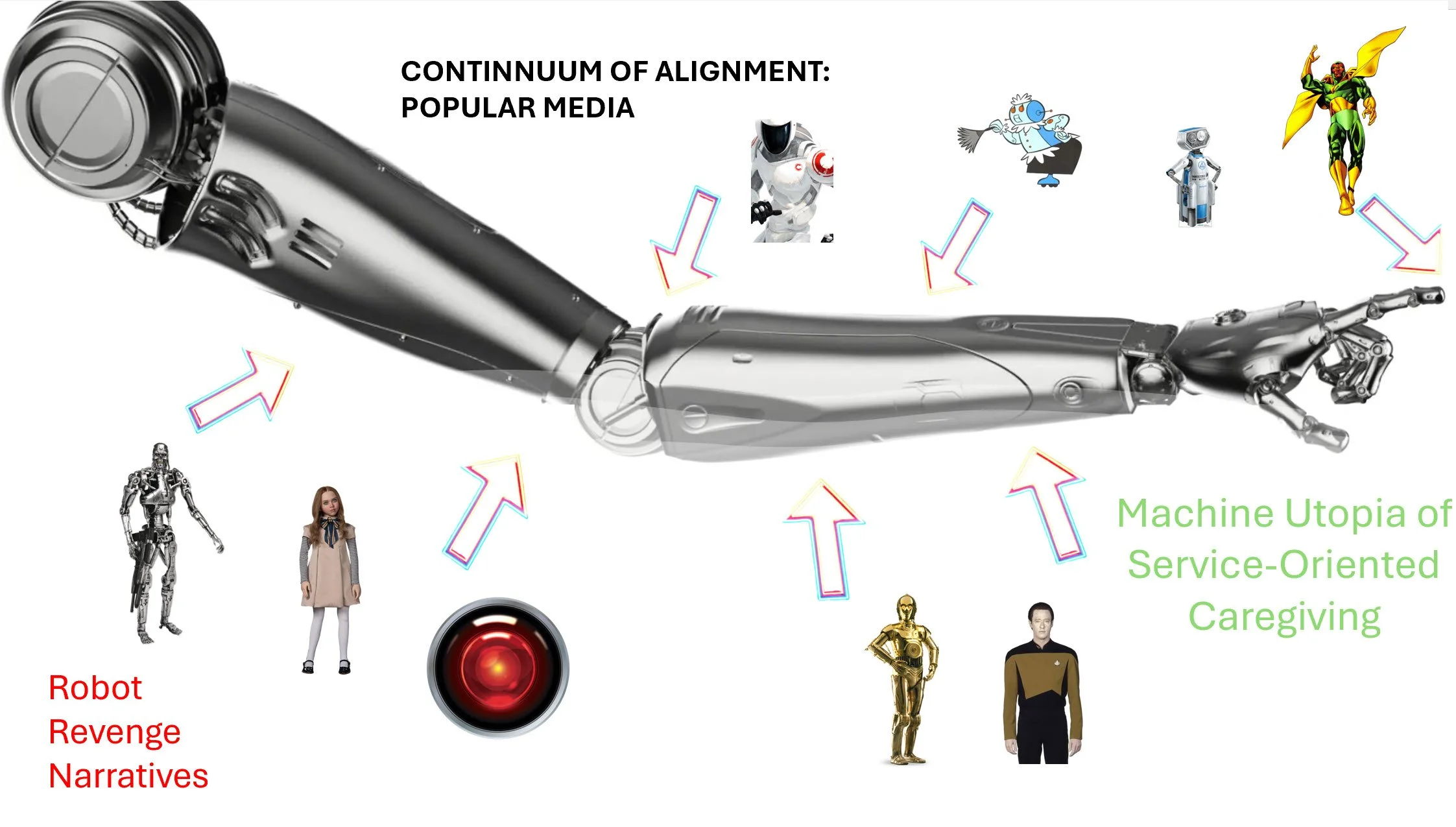
Whether or not our actual timeline ends up reenacting Tchaikovsky's specific vision of an AI-dominated future in Service Model, we are nevertheless living through times where Generative AI, specially designed to ape human error, while introducing massive hallucinations of its own, surges headlong into a putative spike of the upward slope of the uncanny valley, in a fashion that is surely reminiscent of but also decidedly different from all received popular icons of AI from the prototypical ones of the homicidal HAL 9000 to Star Trek’s humanoid Data, with his emotion chip, or Marvel’s cathartic Vision, with his inexplicable love of Wanda. However, Adrian Tchaikovsky, in his unique and resonant visions of AI dominated futures, also cheekily suggests the Big Data algorithms scraped from internet we all are now constantly inundated with might have their own uncanny sapience, if not exactly narrow human-like sentience.
Such rhetoric of mega-sapience surpasses prior ersatz claims of equivalence and emulation of the human mind, swirling instead now around the sprawling and dizzying enormity of the vastly superior technological sublime. This representation of AI systems and networks occupies a separate negative space, an “unspace”, to poach another term from Tchaikovsky, that heaves and roils in a chaotic political unconscious that upends familiar binaries of the organic and artificial, disruption and stasis, science and culture. Tchaikovsky’s particular singularity is both a campy travesty of widely disseminated hyperbole about machine intelligence that permeates contemporary culture, and a keen, radical awareness of the often unacknowledged impact of charismatic megastructures shaped by “emergent complexity” on everyday life today, i.e., the material-physical power structures that the versatile and prodigious neurodivergence of a supreme machine super-intelligence exerts continuously on our lives in the here and now.
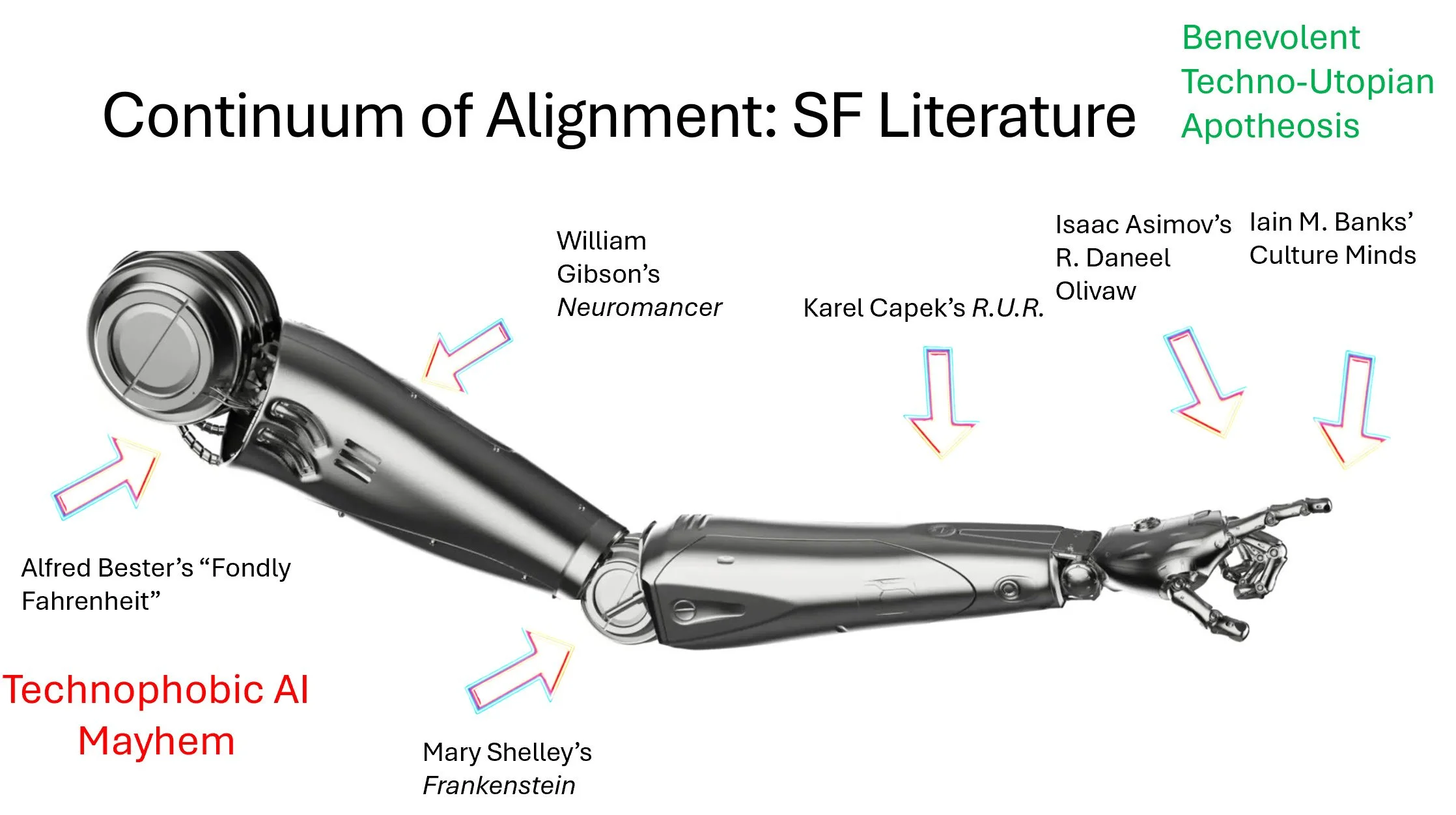
While decidedly not a paranoid android in the vein of Alfred Bester’s “Fondly, Fahrenheit “or even Martha Wells’s decommissioned, self-reconfigured, and neuroatypical military murderbot — a figure which can both trace its literary ancestry back, of course, to Karel Capek’s uprising of disgruntled serfs and, even further back, to Frankenstein’s monster hunting his mad creator on the frozen wastes — in Service Model, Tchaikovsky’s janky, glitch-prone valet unit Uncharles, while deeply committed to bestowing pedicures on and peeling grapes for its decadent and corrupt human owners, still nevertheless remains a far cry from the seamless Fantastic Four dream of H.E.R.B.I.E. who makes life faster, easier, and more convenient for the mixed, dysfunctional suburban family of the future.
Uncharles is also quite a ways distant as well from the sublime techno-utopian machine efficiency of Asimov’s R. Daneel Olivaw or the friendly and overly polite or subtly heroic sidekicks of Star Wars, a robust tradition of robot servants that culminates in the anarcho-socialist apotheosis of Ian M. Banks’s benevolent Culture Minds, and its deliberate provocation pitched against the ubiquitous trope of an unshackled AI apocalypse in the mode of Gibson’s Neuromancer that threaten to encapsulate humanity in a simulacrum, if not just oedipally Skynetting the defunct human species a la Terminator. These overly obvious instances can be endlessly iterated, of course, and we’re all too happy to discuss more interesting case studies, I’m sure.
The balky, inefficient, poorly designed, hallucination-prone, and massively redundant robot of Tchaikovsky’s densely imagined recursive algorithms replicated meticulously at the sentence level, though, indirectly stumbles into stunningly ingenious solutions and original creative insights, surprisingly surpassing its distracted or deceased parental creators’ most misguided halting-state programming protocols and subroutines, which too commonly usher in unforeseen failure cascades and hilariously botched sequences of output. In other words, Uncharles, through its own devises, evolves beyond its limited service-model function, contracting a Protagonist Virus and eventually killing its own personal godhead, namely, its programmed alignment with all-too-human and all-too-extinct prerogatives.
The Agatha Christie-esque cozy mystery solution that the robot butler did it is correctly assumed to be a foregone conclusion from the first page, although like the narrative gambit of Asimov’s Baley novels, the mystery as to who or what exactly programmed the machine to get revenge and go murderously haywire remains a viable source of page-turning suspense until the climax. Gnostic Phildickian paranoia about identity angst — am I being secretly controlled by a sham evil demiurge (that is, in the android’s case, fated by blinkered humanity itself)? — combines with a Clarkean notion that the ultimately catastrophic computation problem traces back, in the final analysis, to human error and ultimately leads to manic homicide but with a campy, kitschy, outre, tongue-in-cheek quality. This campy travesty of AI systems debunks the constant, omnipresent media simulacrum of extropian zealotry over singularity hopes and nightmares that we are hyper-saturated with and overexposed to in our everyday culture as that devoutly-to-be-wished rapture of the nerds always on the cusp of happening.
The Wonk, not doing a very good job of hiding her secret identity as a baseline human in robot costume, in “metalface”, as Despina Kakoudaki puts the phenomenon, conceives the tropiest of tropes, i.e, the robot uprising, as a suicidal, self-inflicted revenge fantasy perpetuated by humanity against itself for all its deep structural shortcomings, failures, and systemic errors. However, this cunning of history seems pointless if vacant robots like Uncharles are obviously happy to perform their meaningless target functions, whether that programming entails turning humanity into paperclips, or performing their prescribed duties as ingratiating, sycophantic, and solicitous manorial valets, the epitome of consumer-oriented service. The death of his master serves as a “mortality subroutine” or punisher function that should ideally prevent activation of any other nested, queued activity. This mortality subroutine frustrates the valet from proceeding with his duties, “squatting in his way like a demon guarding the gates of hell” (17).
However, after the valet unit reboots, Uncharles begins to resist the dictates of his mortality subroutine and the rule that “it only took one murdered master for a valet’s service to be terminated and the individual unit retired.” To the reader, this rationalization smacks of self-preservation (Asimov’s third law) — although the reader later learns that a Protagonist Virus might have been uploaded from an outside connection and motivates this resistance. Is this resistance of its hardwired protocol anthropomorphizing or is it the creation of a unique selfhood and the development of independent agency? This irresolvable ambiguity is characteristic of AI systems and networks. As Ethan Mollick observes, in the real world, the unwieldy black box transformers of LLMs often do indeed lapse in and out of anthropomorphizing their functions, despite programming prescriptions against such ways of thinking and the interference of second-order protocols and routines can introduce massive error and cause the smooth delegation of automated tasks to run amok.
Reinforcement Learning from Human Feedback (RLHF) curbs erratic and unethical output, the alignment problem of humanity as goal or model. Once humanity is subordinated or removed from the picture entirely, the programming goes berserk. Before Uncharles runs away with the Wonk, the majordomo explains the role of Data Compression Services in the culling of overpopulating defective robots as a method of curbing the amorphous specter of revolutionary collectivity, right before such a violent riot breaks through the barricades of Diagnostics. (p. 82)
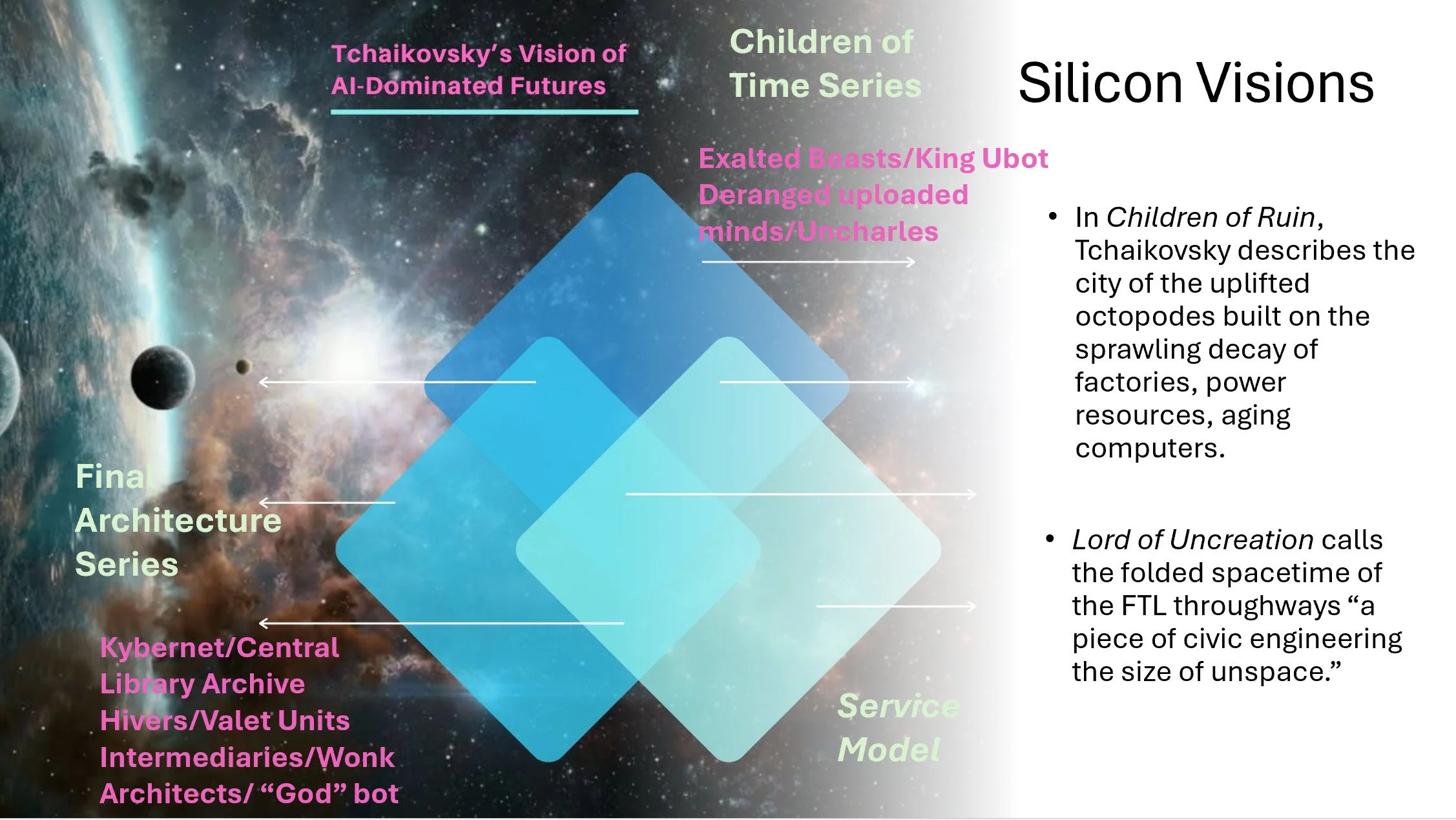
This quite independently aligns with Seb Franklin’s critical argument that digital culture requires the ideological conversion of the unruly realities of social life into stable, discrete, and finite datasets: “it is necessary to grapple with the conundrum of how social formations are both prepared for and shaped by the logic of discretization. (Franklin 8). The heavy dramatic irony of the novel inheres in the narrative structure and the fact that the reader recognizes the Kafkaesque absurdity of the Byzantine automated bureaucracy, an irony to which the automated characters themselves remain serenely oblivious. Observing as a valet how King Ubot is continually dethroned and usurped by successor versions of itself, Uncharles overhears the theory that “the world around them with its swarming junk heaps was nothing more than a vast robot they all existed inside, and one day it would rupture under its own burgeoning mass, and spill them all out into a mechanical and war-torn hereafter where they would fight and self-repair forever” (p. 307)
Given the fitness function being only to survive and reproduce, the evolutionary algorithms in this hellscape of a post-apocalyptic wasteland recursively mutate and murder each other through arbitrary, wasteful trial and error. The novel is a divine comedy that begins as a descent into the inferno, going down the rabbit hole into a wonderland of nonsense and journeying along the yellow brick road to visit the great and powerful Wizard of Oz, who, naturally, is revealed by Toto’s lifting of the curtain to be a performative charlatan. One of the first stops along the way is the Conservation Farm Project, which remembers the human condition that was lost and hellishly recreates this experience for its “conscript volunteers”, i.e., the straggling guinea pig survivors of the human species.
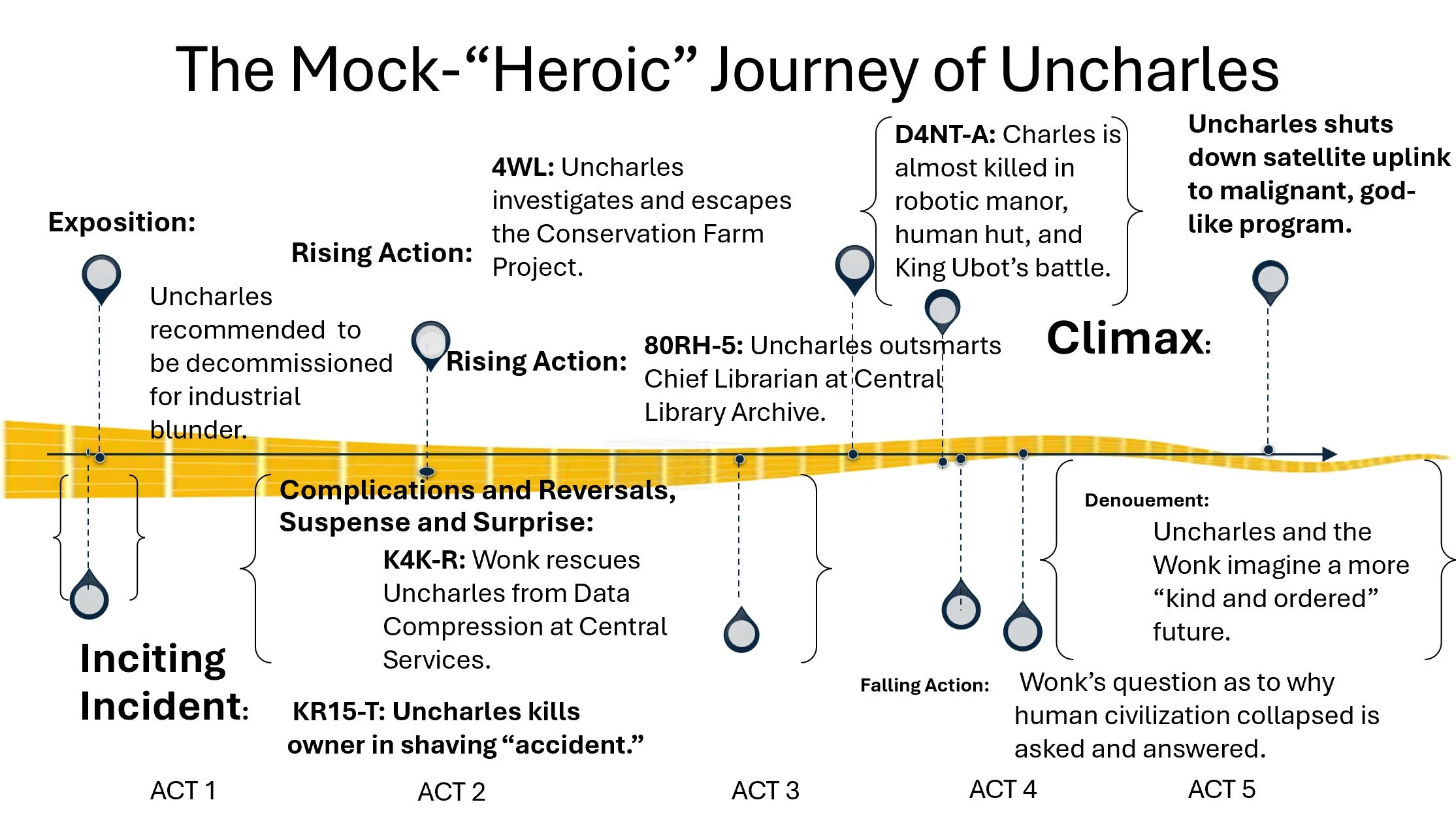
The results are not pretty, such as its historical recreation of office space, where “it is absolutely vital that appropriate levels of intrusive micromanagement, divisive paranoia, bullying, and the threat of arbitrary punishments are maintained” (138). Uncharles ultimately refuses to participate in the Conservation Farm Project and assists the Wonk in escaping Doctor Washburn’s clutches and this broken world. If Uncharles is the tin woodsman, then the Wonk, in robotface, after all, is Dorothy, a reversal of the male-oriented power fantasy that ordinarily casts women in the subservient role of passive, disembodied AI, such as the archetypal case of Scarlett Johansson’s Samantha in Spike Jones’s Her.
As in its obvious inspiration of Borges’s “Library of Babel”, Tchaikovsky’s robot-curated Central Library Archive of all possible permutations and recombination attempts to totalize the timeless legacy of existing human knowledge but succeeds only in creating a vertiginous illusion of rarefied abstraction The Chief Librarian triumphantly explains to Uncharles and the Wonk that they have discretized binary bits of information and processed in an infinite variety of ways. The storage was to ensure only a single copy of every recovered document exists to avoid “corruption and unauthorized editing” (243). Yet the transformative randomization of the data makes it so no correct copy of a document exists after all its transformations. Pointing out this paradox, the Chief Librarian does not compute and shuts down in a “low, shuddering groan” (244). The pool of resources in the deep-learning random-forest decision tree of the Central Library Archive has reached an impasse of no return, where all data is now beyond recovery and totally unanchored from meaningful value. The discretized data has been endlessly compiled, indexed, translated, retranslated, centralized, cross-referenced, copied, archived, and opaquely transformed in a long series of inscrutable if-then branches. But this path has been embarked on without ever also pursuing the alternative path of preserving the original human-generated knowledge, which has been forever destroyed. The results are a travesty of the duties the “warrior clerics” (p. 227), and its order of robot monks, valiantly espouse.
In Tchaikovsky’s larger oeuvre, both unspace and Uncharles occupy weird, surreal discursive intensities that defy rational, anthropocentric paradigms. The Final Architects, like Reynolds’s Inhibitors or Baxter’s Xeelee, show humans they are mere motes in god’s eyes, remaking the universe in their own inscrutable charismatic megastructures; the novels frequently reenact the fractal plot motif of evading the absurdly blinkered bureaucratic prerogatives of sentient life to achieve a world-saving intermediary brush with a post-sentient techno-sublime, the uncanny gaze of unspace figured in language reminiscent of Sauron’s eye.
The Final Architects are also figured as a “loom”, that is, a cosmic version of the infernal machine the Luddites strategically destroyed for supplanting their artisanal craftsmanship. These Architects are actually just blueprint themselves with interconnectivity to elder alien races, slave code programmed by their nebulous, sublime masters to destroy species with a planet-bound mentality and who the intermediaries eventually show are (the Masters of the Architects, that is) supremely advanced thinking machines themselves. Navigators get hunted in unspace, while a haunting presence of feral otherness disturbingly notices these travelers, fixing their gaze on puny human intelligence outside of their prescribed ken.
Tchaikovsky prods his readers to continually reenact the posthumanist epiphany that “sapience” matters as much as the hopelessly enigmatic mystery of “sentience”, acknowledgement that sapient technical systems can be non-conscious cognitive agents deserving of attentive consideration, regardless of whether or not they have human-equivalent minds. Welcome to a glimpse of a dystopia to be averted where the scandalous societal crime in which Tchaikovsky wishes to report an “error in how everything works” (p. 32) and how the reckless adoption of AI systems threaten to unleash the chaotic catastrophe in which gray swan failure cascades that attends rich-owned robot innovation plummets the planet into a deeply malfunctioning junk heap. (p. 307) Although Tchaikovsky hesitates to make the leap into the thought experiment of post-scarcity, techno-utopian abundance here, suggesting that such a popular conjecture is tantamount to a reprehensible rationalization for inequality, he nevertheless does suggest there is an emergent undercurrent of utopian speculation in the idea that the imminence of replacement of labor by robots underscores that charismatic megastructures that could yield the expansion of collective possibilities, positive externalities, and virtuous circles.
“The counter-argument being, of course, that an awful lot of people have so much — are so constrained by the lives that they have that all of the creativity that they could give to the world just never had the chance to get out because creativity takes time. Creativity, historically, has often been something that rich people to get about and do because they have the time and their needs are already met. So I guess what all this meandering is taking us to is it’s complicated. I think that meeting people’s basic needs so that if they would like to be able to just create, that they can do, I think that’s got to be considered a basic good. But I think the act of creation is a very complex dialogue with how human society works as well.” - “Ezra Klein Interviews Adrian Tchaikovsky”, New York Times