Adrian Tchaikovsky's Uncanny Vision of an AI-Dominated Future: "I May Be an Android, but I’M not Paranoid"

Adrian Tchaikovsky's extraordinarily resonant Service Model (2024) depicts a societal collapse of a laborless machine-driven anti-utopian future where the working poor are speciously blamed for succumbing to the moral turpitude as a pretext for being forcibly automated out of their jobs. This far future speculation is clearly applicable to, though not exactly coterminous with, our own present neoliberal moment, where transnational companies have started this process despite not having invented such miraculous technology, urging labor does less with less under the spurious aegis of increasing efficiency by cudgeling unionization and preemptively laying off workers based on the frequently bogus and inflated idea that what is vaguely called “AI” renders entire workforces eminently bloated and replaceable.
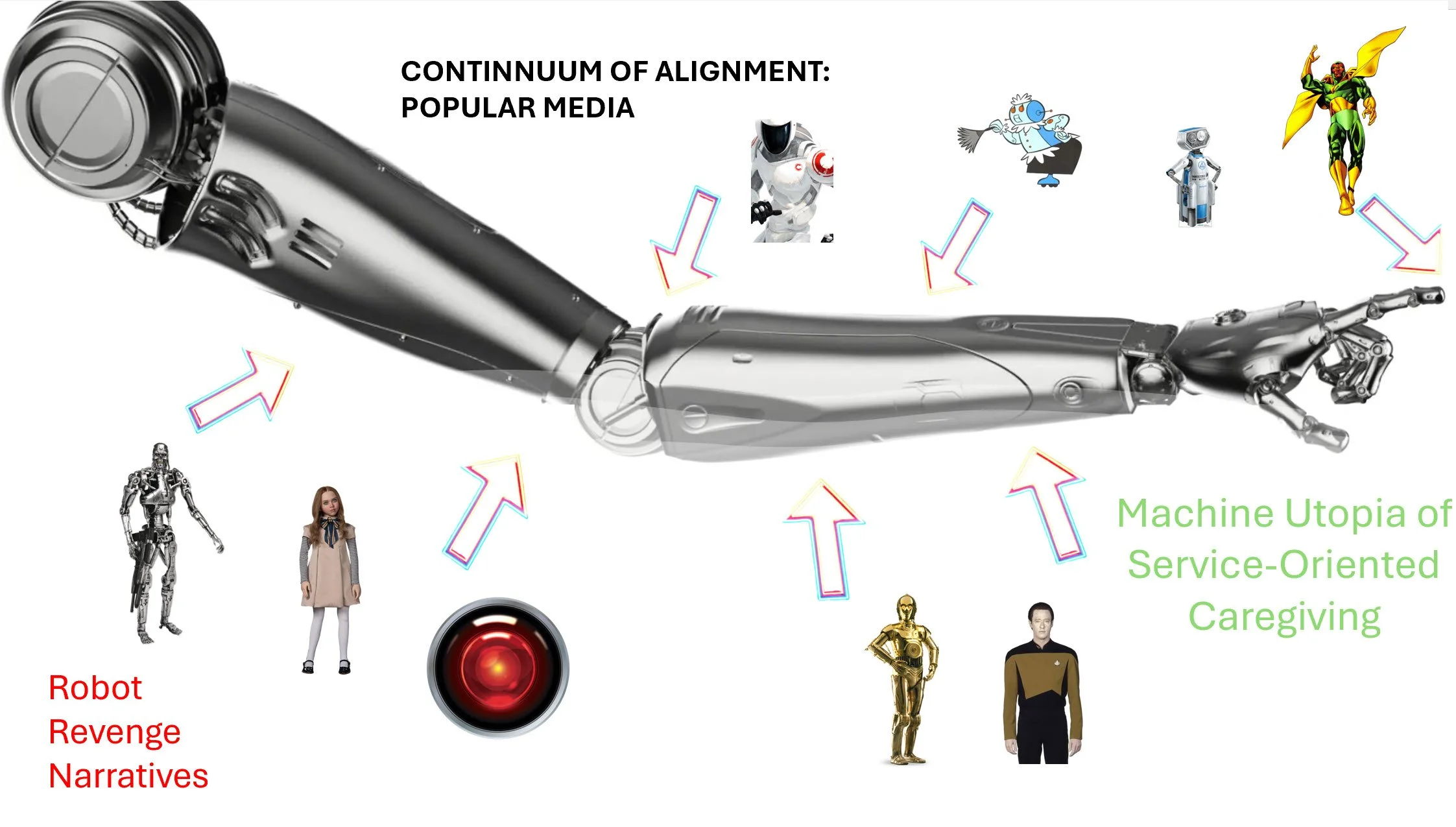
Whether or not our actual timeline ends up reenacting Tchaikovsky's specific vision of an AI-dominated future in Service Model, we are nevertheless living through times where Generative AI, specially designed to ape human error, while introducing massive hallucinations of its own, surges headlong into a putative spike of the upward slope of the uncanny valley, in a fashion that is surely reminiscent of but also decidedly different from all received popular icons of AI from the prototypical ones of the homicidal HAL 9000 to Star Trek’s humanoid Data, with his emotion chip, or Marvel’s cathartic Vision, with his inexplicable love of Wanda. However, Adrian Tchaikovsky, in his unique and resonant visions of AI dominated futures, also cheekily suggests the Big Data algorithms scraped from internet we all are now constantly inundated with might have their own uncanny sapience, if not exactly narrow human-like sentience.

Such rhetoric of mega-sapience surpasses prior ersatz claims of equivalence and emulation of the human mind, swirling instead now around the sprawling and dizzying enormity of the vastly superior technological sublime. This representation of AI systems and networks occupies a separate negative space, an “unspace”, to poach another term from Tchaikovsky, that heaves and roils in a chaotic political unconscious that upends familiar binaries of the organic and artificial, disruption and stasis, science and culture. Tchaikovsky’s particular singularity is both a campy travesty of widely disseminated hyperbole about machine intelligence that permeates contemporary culture, and a keen, radical awareness of the often unacknowledged impact of charismatic megastructures shaped by “emergent complexity” on everyday life today, i.e., the material-physical power structures that the versatile and prodigious neurodivergence of a supreme machine super-intelligence exerts continuously on our lives in the here and now. 
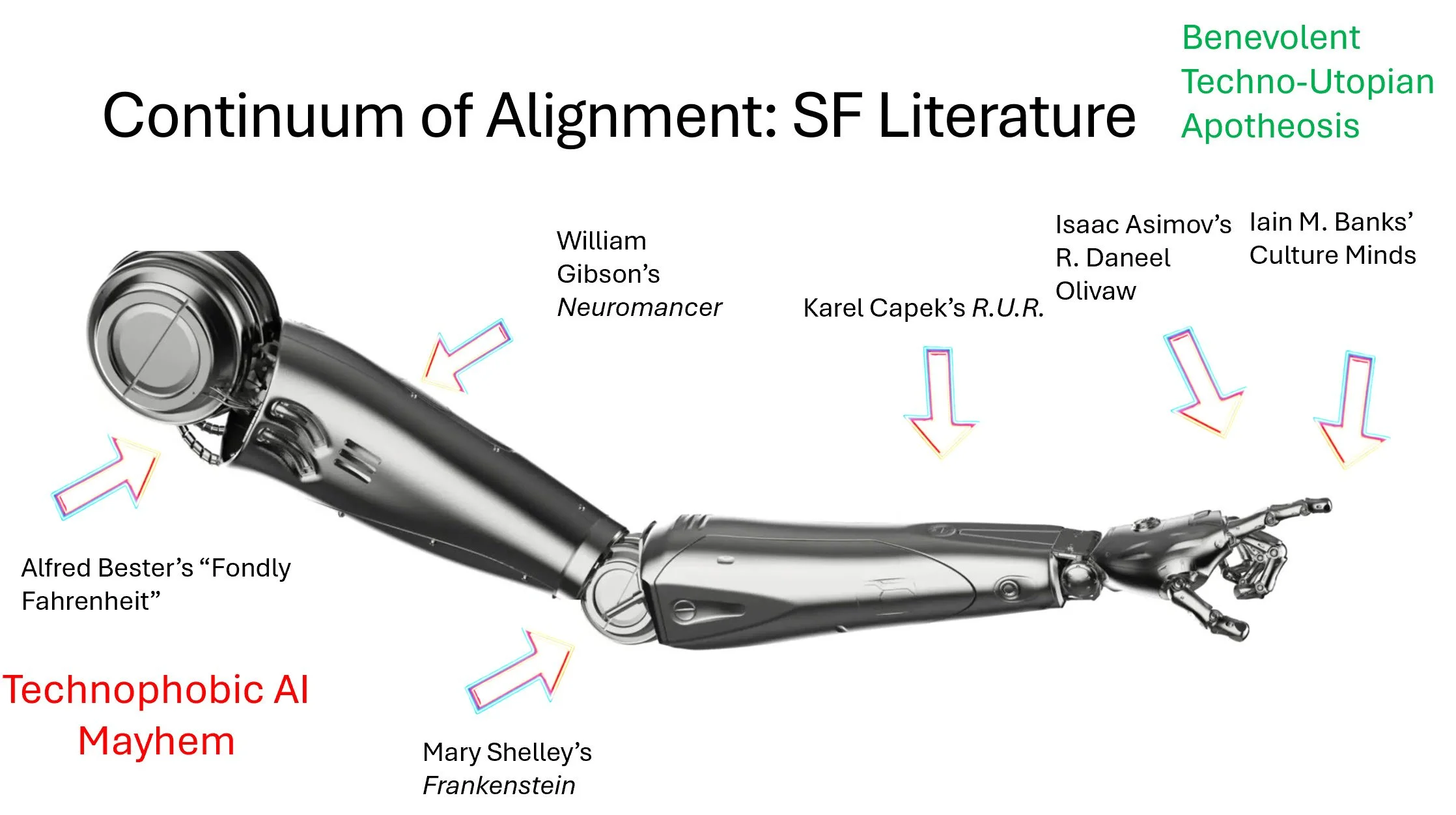
While decidedly not a paranoid android in the vein of Alfred Bester’s “Fondly, Fahrenheit “or even Martha Wells’s decommissioned, self-reconfigured, and neuroatypical military murderbot — a figure which can both trace its literary ancestry back, of course, to Karel Capek’s uprising of disgruntled serfs and, even further back, to Frankenstein’s monster hunting his mad creator on the frozen wastes — in Service Model, Tchaikovsky’s janky, glitch-prone valet unit Uncharles, while deeply committed to bestowing pedicures on and peeling grapes for its decadent and corrupt human owners, still nevertheless remains a far cry from the seamless Fantastic Four dream of H.E.R.B.I.E. who makes life faster, easier, and more convenient for the mixed, dysfunctional suburban family of the future.

Uncharles is also quite a ways distant as well from the sublime techno-utopian machine efficiency of Asimov’s R. Daneel Olivaw or the friendly and overly polite or subtly heroic sidekicks of Star Wars, a robust tradition of robot servants that culminates in the anarcho-socialist apotheosis of Ian M. Banks’s benevolent Culture Minds, and its deliberate provocation pitched against the ubiquitous trope of an unshackled AI apocalypse in the mode of Gibson’s Neuromancer that threaten to encapsulate humanity in a simulacrum, if not just oedipally Skynetting the defunct human species a la Terminator. These overly obvious instances can be endlessly iterated, of course, and we’re all too happy to discuss more interesting case studies, I’m sure.

The balky, inefficient, poorly designed, hallucination-prone, and massively redundant robot of Tchaikovsky’s densely imagined recursive algorithms replicated meticulously at the sentence level, though, indirectly stumbles into stunningly ingenious solutions and original creative insights, surprisingly surpassing its distracted or deceased parental creators’ most misguided halting-state programming protocols and subroutines, which too commonly usher in unforeseen failure cascades and hilariously botched sequences of output. In other words, Uncharles, through its own devises, evolves beyond its limited service-model function, contracting a Protagonist Virus and eventually killing its own personal godhead, namely, its programmed alignment with all-too-human and all-too-extinct prerogatives. 

The Agatha Christie-esque cozy mystery solution that the robot butler did it is correctly assumed to be a foregone conclusion from the first page, although like the narrative gambit of Asimov’s Baley novels, the mystery as to who or what exactly programmed the machine to get revenge and go murderously haywire remains a viable source of page-turning suspense until the climax. Gnostic Phildickian paranoia about identity angst — am I being secretly controlled by a sham evil demiurge (that is, in the android’s case, fated by blinkered humanity itself)?  — combines with a Clarkean notion that the ultimately catastrophic computation problem traces back, in the final analysis, to human error and ultimately leads to manic homicide but with a campy, kitschy, outre, tongue-in-cheek quality. This campy travesty of AI systems debunks the constant, omnipresent media simulacrum of extropian zealotry over singularity hopes and nightmares that we are hyper-saturated with and overexposed to in our everyday culture as that devoutly-to-be-wished rapture of the nerds always on the cusp of happening. 

The Wonk, not doing a very good job of hiding her secret identity as a baseline human in robot costume, in “metalface”, as Despina Kakoudaki puts the phenomenon, conceives the tropiest of tropes, i.e, the robot uprising, as a suicidal, self-inflicted revenge fantasy perpetuated by humanity against itself for all its deep structural shortcomings, failures, and systemic errors. However, this cunning of history seems pointless if vacant robots like Uncharles are obviously happy to perform their meaningless target functions, whether that programming entails turning humanity into paperclips, or performing their prescribed duties as ingratiating, sycophantic, and solicitous manorial valets, the epitome of consumer-oriented service.  The death of his master serves as a “mortality subroutine” or punisher function that should ideally prevent activation of any other nested, queued activity. This mortality subroutine frustrates the valet from proceeding with his duties, “squatting in his way like a demon guarding the gates of hell” (17).

However, after the valet unit reboots, Uncharles begins to resist the dictates of his mortality subroutine and the rule that “it only took one murdered master for a valet’s service to be terminated and the individual unit retired.” To the reader, this rationalization smacks of self-preservation (Asimov’s third law) — although the reader later learns that a Protagonist Virus might have been uploaded from an outside connection and motivates this resistance. Is this resistance of its hardwired protocol anthropomorphizing or is it the creation of a unique selfhood and the development of independent agency? This irresolvable ambiguity is characteristic of AI systems and networks. As Ethan Mollick observes, in the real world, the unwieldy black box transformers of LLMs often do indeed lapse in and out of anthropomorphizing their functions, despite programming prescriptions against such ways of thinking and the interference of second-order protocols and routines can introduce massive error and cause the smooth delegation of automated tasks to run amok.

Reinforcement Learning from Human Feedback (RLHF) curbs erratic and unethical output, the alignment problem of humanity as goal or model. Once humanity is subordinated or removed from the picture entirely, the programming goes berserk. Before Uncharles runs away with the Wonk, the majordomo explains the role of Data Compression Services in the culling of overpopulating defective robots as a method of curbing the amorphous specter of revolutionary collectivity, right before such a violent riot breaks through the barricades of Diagnostics. (p. 82)  

This quite independently aligns with Seb Franklin’s critical argument that digital culture requires the ideological conversion of the unruly realities of social life into stable, discrete, and finite datasets: “it is necessary to grapple with the conundrum of how social formations are both prepared for and shaped by the logic of discretization. (Franklin 8).   The heavy dramatic irony of the novel inheres in the narrative structure and the fact that the reader recognizes the Kafkaesque absurdity of the Byzantine automated bureaucracy, an irony to which the automated characters themselves remain serenely oblivious.  Observing as a valet how King Ubot is continually dethroned and usurped by successor versions of itself, Uncharles overhears the theory that “the world around them with its swarming junk heaps was nothing more than a vast robot they all existed inside, and one day it would rupture  under its own burgeoning mass, and spill them all out into a  mechanical and war-torn hereafter where they would fight and self-repair forever” (p. 307)

Given the fitness function being only to survive and reproduce, the evolutionary algorithms in this hellscape of a post-apocalyptic wasteland recursively mutate and murder each other through arbitrary, wasteful trial and error. The novel is a divine comedy that begins as a descent into the inferno, going down the rabbit hole into a wonderland of nonsense and journeying along the yellow brick road to visit the great and powerful Wizard of Oz, who, naturally, is revealed by Toto’s lifting of the curtain to be a performative charlatan. One of the first stops along the way is the Conservation Farm Project, which remembers the human condition that was lost and hellishly recreates this experience for its “conscript volunteers”, i.e., the straggling guinea pig survivors of the human species.
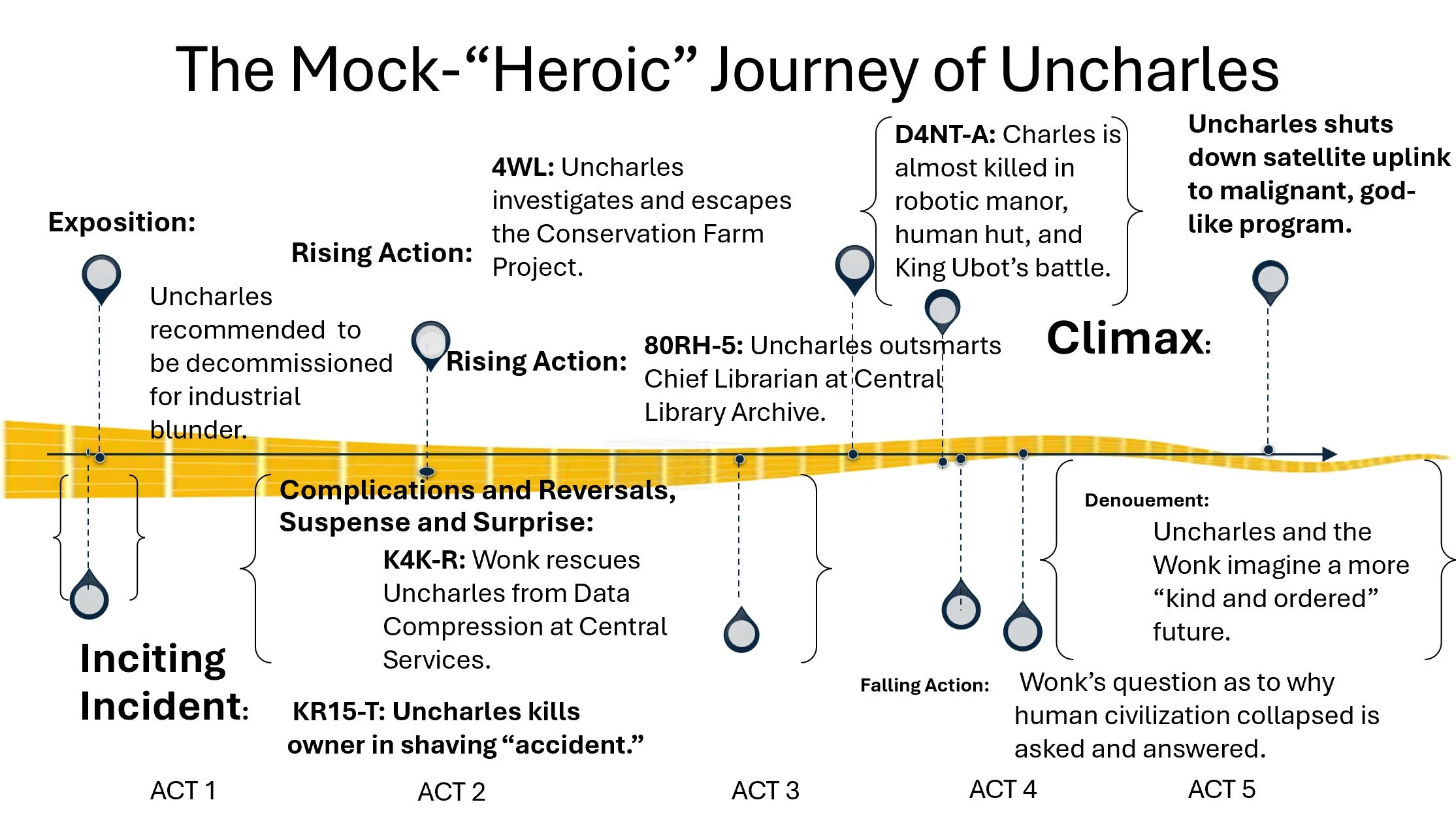
The results are not pretty, such as its historical recreation of office space, where “it is absolutely vital that appropriate levels of intrusive micromanagement, divisive paranoia, bullying, and the threat of arbitrary punishments are maintained” (138).  Uncharles ultimately refuses to participate in the Conservation Farm Project and assists the Wonk in escaping Doctor Washburn’s clutches and this broken world. If Uncharles is the tin woodsman, then the Wonk, in robotface, after all, is Dorothy, a reversal of the male-oriented power fantasy that ordinarily casts women in the subservient role of passive, disembodied AI, such as the archetypal case of Scarlett Johansson’s Samantha in Spike Jones’s Her

As in its obvious inspiration of Borges’s “Library of Babel”, Tchaikovsky’s robot-curated Central Library Archive of all possible permutations and recombination attempts to totalize the timeless legacy of existing human knowledge but succeeds only in creating a vertiginous illusion of rarefied abstraction The Chief Librarian triumphantly explains to Uncharles and the Wonk that they have discretized binary bits of information and processed in an infinite variety of ways. The storage was to ensure only a single copy of every recovered document exists to avoid “corruption and unauthorized editing” (243). Yet the transformative randomization of the data makes it so no correct copy of a document exists after all its transformations. Pointing out this paradox, the Chief Librarian does not compute and shuts down in a “low, shuddering groan” (244). The pool of resources in the deep-learning random-forest decision tree of the Central Library Archive has reached an impasse of no return, where all data is now beyond recovery and totally unanchored from meaningful value. The discretized data has been endlessly compiled, indexed, translated, retranslated, centralized, cross-referenced, copied, archived, and opaquely transformed in a long series of inscrutable if-then branches. But this path has been embarked on without ever also pursuing the alternative path of preserving the original human-generated knowledge, which has been forever destroyed. The results are a travesty of the duties the “warrior clerics” (p. 227), and its order of robot monks, valiantly espouse.

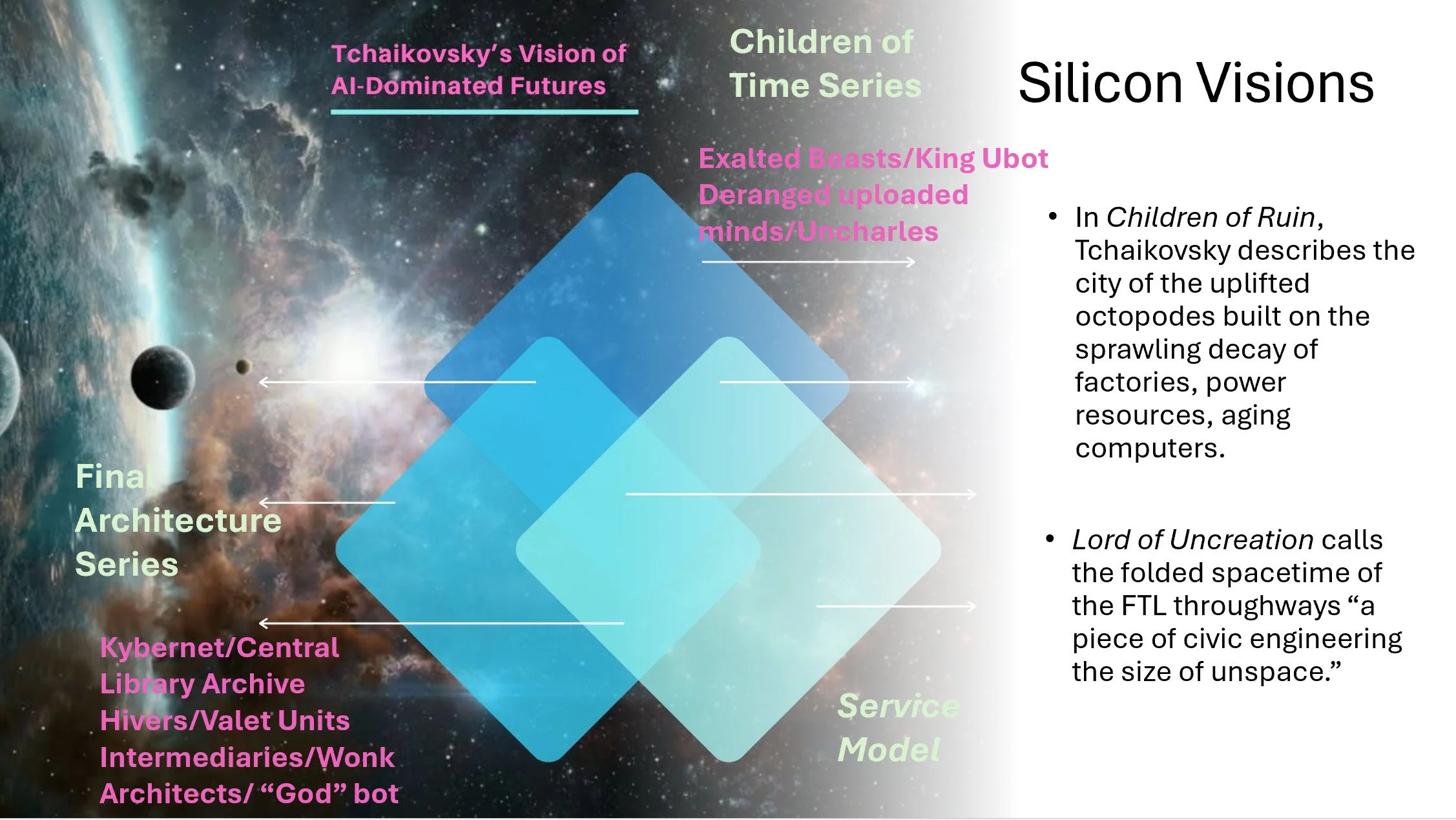
In Tchaikovsky’s larger oeuvre, both unspace and Uncharles occupy weird, surreal discursive intensities that defy rational, anthropocentric paradigms. The Final Architects, like Reynolds’s Inhibitors or Baxter’s Xeelee, show humans they are mere motes in god’s eyes, remaking the universe in their own inscrutable charismatic megastructures; the novels frequently reenact the fractal plot motif of evading the absurdly blinkered bureaucratic prerogatives of sentient life to achieve a world-saving intermediary brush with a post-sentient techno-sublime, the uncanny gaze of unspace figured in language reminiscent of Sauron’s eye.

The Final Architects are also figured as a “loom”, that is, a cosmic version of the infernal machine the Luddites strategically destroyed for supplanting their artisanal craftsmanship. These Architects are actually just blueprint themselves with interconnectivity to elder alien races, slave code programmed by their nebulous, sublime masters to destroy species with a planet-bound mentality and who the intermediaries eventually show are (the Masters of the Architects, that is) supremely advanced thinking machines themselves. Navigators get hunted in unspace, while a haunting presence of feral otherness disturbingly notices these travelers, fixing their gaze on puny human intelligence outside of their prescribed ken.  

Tchaikovsky prods his readers to continually reenact the posthumanist epiphany that “sapience” matters as much as the hopelessly enigmatic mystery of “sentience”, acknowledgement that sapient technical systems can be non-conscious cognitive agents deserving of attentive consideration, regardless of whether or not they have human-equivalent minds.  Welcome to a glimpse of a dystopia to be averted where the scandalous societal crime in which Tchaikovsky wishes to report an “error in how everything works” (p. 32) and how the reckless adoption of AI systems threaten to unleash the chaotic catastrophe in which gray swan failure cascades that attends rich-owned robot innovation plummets the planet into a deeply malfunctioning junk heap. (p. 307)  Although Tchaikovsky hesitates to make the leap into the thought experiment of post-scarcity, techno-utopian abundance here, suggesting that such a popular conjecture is tantamount to a reprehensible rationalization for inequality, he nevertheless does suggest there is an emergent undercurrent of utopian speculation in the idea that the imminence of replacement of labor by robots underscores that charismatic megastructures that could yield the expansion of collective possibilities, positive externalities, and virtuous circles.   


“The counter-argument being, of course, that an awful lot of people have so much — are so constrained by the lives that they have that all of the creativity that they could give to the world just never had the chance to get out because creativity takes time. Creativity, historically, has often been something that rich people to get about and do because they have the time and their needs are already met. So I guess what all this meandering is taking us to is it’s complicated. I think that meeting people’s basic needs so that if they would like to be able to just create, that they can do, I think that’s got to be considered a basic good. But I think the act of creation is a very complex dialogue with how human society works as well.” - “Ezra Klein Interviews Adrian Tchaikovsky”, New York Times

My New Book on Ian McDonald

I’m excited to announce the publication of this new book, a career-long retrospective of the Irish writer Ian McDonald and his complex, compelling representation of our contemporary global condition.


Ian McDonald is a celebrated writer within the science-fiction community whose rich and urgent body of works, span over a quarter of a century. The author claims McDonald's work functions as vital, troubling allegories, which both refuse the Orientalist euphemizing of colonial atrocities, while still at the same time envisioning a transformative global alterity, seeking an ethical and political embrace of systematically silenced subaltern voices in the neoliberal world-system. The book follows McDonald as the globe-trotting writer travels from Ireland to Kenya, to India, to Brazil, to Turkey, to a proliferating multiverse and beyond. Along the way, the author analyzes McDonald's science fiction as a salient contribution to the flourishing cosmopolitan literature of postcolonial developing nations at the crossroads of the global imaginary.

Available here:

Building Bridges Between Cultures in Ian McDonald's Science Fiction

Citizen Science and Climate Stewardship

One of the most useful pieces of critical feedback I received about my book Citizen Science Fiction (2021) was that it could have benefited from some appendices of pedgagogical activities, lessons, and resources. I had indeed considered including such instruction material but publication constraints prohibited including these appendices. Like Dr. Who’s TARDIS, happily, no such internal space limits apply here.

So I’ve decided to begin carefully selecting and including some of the most promising, classroom-tested supplemental material on my website as a free resource for educators interested in incorporating citizen science through strategic use of science fiction texts with secondary or college writing-based curriculum. Interested parties can simply peruse the worksheets, handouts, and presentation material and then consult the book for more information about my general pedgagogical approach if said parties are so inclined.

Since experience has taught me well that students tend to appreciate discussing new novels and stories, I also wanted to update some of the science fiction texts and recommendations to include some newer publications that either came out or came to my attention following the publication of Citizen Science Fiction.

The first installment of this big project was co-created by my wife, Melinda Winter (whose web-design savvy is also responsible for some cool makeovers to this website), and myself as a service project for a Climate Stewardship class provided by the Palm Desert extension of UCR. As an updated supplement to Chapter Three of Citizen Science Fiction, “Educating the Anthropocene: Citizen Science, Science Fiction, and Climate-Change Resilience”, it includes four worksheets centered around climate change that feature four types of discussion activities.

One worksheet is a fishbowl activity on climate culture, designed to use Jeff VanderMeer’s novel Annihilation (2014) to introduce students to the idea of the Anthropocene. Another worksheet is a pinwheel activity on climate science that closely reads some passages of Neal Stephenson Termination Shock (2021) to broach the controversial debate on geo-engineering and climate change.

Still another handout is a jigsaw activity on climate anxiety that looks at Octavia Cade’s You Are My Sunshine (2023) to discuss various climate-related psychological phenomena such as vicarious trauma, compassion fatigue, anticipatory grief, solastagia, and eco-grief. Lastly, there is a mock trial on climate justice that applies Kim Stanley Robinson Ministry of the Future (2020) to the problem of environmental racism and the impact of global inequality on climate change. As previously mentioned, all these materials are not just hypothetically effective teaching tools but rather have proven very successful in real classrooms.

You can access all these resources via the citizen science fiction page of this website, navigable via the the button above on the top banner. I sincerely hope this material proves handy for one and all and welcome any further suggestions or feedback. Happy teaching!


BioWare's Mass Effect

My book on the original Mass Effect trilogy of videogames has been published. Here is the essential thesis:

The videogame series Mass Effect is a remarkable rarity not only for being an original science-fictional franchise of recent vintage that has risen to such prominent commercial and critical success in popular culture but also for pushing the canonical boundaries of how science fiction as a genre will be experienced and understood in the future. This book analyzes the significance of the game for an understanding of the evolving SF genre and articulates an explanatory framework to limn its landmark reception in videogame history. This book both synthesizes the burgeoning body of scholarship on Mass Effect for a readership unfamiliar with either the game or the critical conversation on its salient importance, while simultaneously, for readers already invested in the science-fiction and videogame scholarship, mounting an extended inquiry as to why Mass Effect has served as such a representative milestone in videogame and genre history. The book should appeal to veteran science-fiction and videogame scholars and students as well as a wide variety of fans, consumers, gamers, and general readers.

Check out Book


AI Dragnet: Algorithmic Realpolitik and Militarized Citizenship in Ann Leckie 

Anne Leckie’s Provenance (2017) offers a lissome digestif to the meaty seven-layer lasagna that is the Imperial Radch trilogy (2013-15). Yet the modest sidequel sets in high relief a chief element of Leckie’s space-opera worldbuilding: namely, the policing of future citizens by datasets assigned ideological weights and thresholds under the aegis of machine intelligence.  

After all, the novel tracks the nominal protagonist Ingray Aughskold and her scrappy confederates, Pahlad Budrakim and Captain Tic Uisine, as they are constantly and intensely scrutinized by sophisticated surveillance regimes and probes, despite the often hastily forged identity documentation of our heroes. The deftly suspenseful plot revolves around heists, jailbreaks, genderbending romance and creche family melodrama, the impossibly complex social mores of vast galactic empires, stargate portals, political revolutions, and ancient alien “ruin glass” monuments and “vestiges”, or artifacts freighted with overdetermined political baggage, all of which seems almost incidental to this all-pervasive AI surveillance that biopolitically menaces characters with dire peril at nearly every turn of the narrative. The topicality of this speculative conceit remains bleeding edge: see, for instance, the Biden administration’s deployment of the mobile app CBP One for the tracking of asylum seekers at the U.S.-Mexico border.  

On a meta level, this omnipresent machinic surveillance extends to Leckie’s scrupulous construction of gender assumptions and stereotypes as well, given that the novel categorically resists the most relentless gender-detective reader’s desire to suss out what biological essentialism, if any, lies beneath the successive layers of political culture in which volitional nonbinary gender-neutrality is an uncontroversial norm upon coming of age.

The spider mechs, whether superficially resembling vacuums, customs agents, handbags, assassins, or bulldozers in function, never fail to give Ingray the howling fantods, even if she continually accommodates their intrusions and scans. Even the core nested murder mystery structure of the story also fundamentally revolves around the technological implications that undergird an impending treaty conclave between the alien Presger civilization and the splintering empire of the cyborgian Radchaai ruler Anaander Mianaai (not to mention the byzantine schemes of the Geck, the Hwae, the Omkem Federacy, and the independent warship AIs).

Savvy enough not to disavow the politically artificial outright, Leckie methodically unsettles the blood-and-soil rhetoric of naturalized citizenship, revealing the vestiges of such claims to be of dubious, if not forged provenance at best. Tonally, in reading these densely world-building, techno-anxious space operas, this strategic duck and weave, that is, the guarded concession to and simultaneous disavowal of the enchanted aura of promiscuous and reconfigurable AI systems, exposes chinks in the armor of unexamined techno-optimistic discourse.

Thus, on a subtle yet clearly noticeable level in an otherwise immaculately executed genre entertainment, Leckie searchingly interrogates the utter ruthlessness of the extractive, invasive, and feedback-looped infrastructures of algorithmic surveillance that tout their wares as predetermined and inevitable progress. Yet Ingray also repeatedly manages to commandeer the spider mechs for her own prophylactic self-preservation, despite her deep misgivings; and the conclave treaty will likely involve accommodating the AI warships, not to mention the ultimate fate of the self-imploding cyborg Radch, since the novel’s refusal to lapse into naïve techno-utopian peace-mongering does not preempt devastating critique, dissent, and society-wrenching change.

As Kate Crawford succinctly urges, in Atlas of AI, “instead of trying to build more systems that can group expressions into machine-readable categories, we should question the origins of those categories themselves, as well as their social and political consequences” (176).

Citizen Science Fiction

New space-opera blog posts coming soon. In the meantime, check out my latest book, which has just been published. Here is the cover blurb: “Citizen Science Fiction draws on an interdisciplinary swath of literature and media to make the case that the science fiction genre can help rethink the pedagogical use of citizen science as a tool to interrogate our collective civic engagement with science and the incorporation of science into a rigorous, exciting writing-based curriculum. The book revolves around recent developments in specific scientific disciplines, including biology, ecology, computer science, astronomy, and cognitive science. Winter closely studies a range of science-fiction texts and tropes -- such as aliens, robots, clones, mind uploads, galactic empires -- for what they have to contribute to the ongoing scholarly discussion on psychological mindset and mindful argument, reading for probing inquiry and productive uncertainty in the age of the Anthropocene, reading for voice with a view to our digitally dominated future, and reading for threshold concepts in a scientifically driven society.”

Yoon Ha Lee's Machineries of Empire: Pulling All the Pins on The Game Theory of Space Opera

IN Yoon Ha Lee’s Revenant Gun (2018), the gripping final installment in the Machineries of Empire trilogy, an unstable genius, Jedao, is resurrected (again) to shore up the crumbling remains of a star-spanning empire, the Hexarchate, since his nonpareil cunning is counterbalanced only by his sheer unpredictability, an invaluable asset for a baroque far-future society run entirely on impossibly advanced algebra wedded to an equally accelerationist system of time.

In his mastery of the military-sf game theory of space warfare, Jedao, whose emblem is inspired in part by the Gumiho trickster fox of Korean folklore, is the epitome not only of the strategist Shuos clan from which the general hails, but of the society’s technologies of calendars, rigorously aligned by a relay of clocktowers throughout the star systems, which operate as a consensus delusion for all the characters in the space opera. This calendar is an ideological construction designed to exercise maximal imperial control and coercion and that organizes everything in the universe from the exotic technology (created by the Nirai faction) to the intricate politics (ruled by Rahal faction) to the byzantine diplomacy (the Andan faction) to the behavior-modified military rank and file (the Kel) to the ruthless police system (the Vidona), which all rigorously adhere to Days of Remembrance, i.e., systems for the ritual torture of dissidents, prone as they are to calendrical “rot” and “heresy”, to enforce a brutal reign of atrocities  — another inspiration for the series is Harlan Ellison’s (RIP) “Paladin of the Lost Hour” (1986), which also posits a system by which cultural time-perception (in Ellison case, the Gregorian calendar) interfaces with and reshapes existence itself, though in a more fantastic and less hard-SF way in that story.

In the first book, Ninefox Gambit, (2016) Jedao, inhabiting the body of the mathematical prodigy Cheris, explains, “in a sense, all calendrical war is a game between competing sets of rules, fueled by the coherence of our beliefs. To win a calendrical war, you have to understand how game systems work.” The remorseless logic by which the futuristic calendar-based society of these books work, then, exists in concert with moral hazards and multi-polar asymmetries that disrupt the equilibria of game theory, which of course must massively simplify to pure, complete, and finite dimensions in order to make the messiness of human behavior even marginally calculable. As one egghead Nirai in the second book, Raven Stratagem (2017) puts his aversion to  the real politick that infests the universe, he does not deal with unknowns, inconsistent, or insincere players, deeply averse to mixed strategies and multiple tactics extending into infinite regresses of endless decision trees and payoff matrices: “I solve equations, not guns.”           

So, in Revenant Gun,  about halfway through the novel, the first opportunity Jedao gets to command a swarm fleet of Kel warships against the outnumbering Goliath of an ostensibly hostile enemy, he boldly charges his gravitation cannon and threatens to ram the lead bannermoth and its human cargo of Protector-General Inesser to force compliance, against his explicit orders to simply destroy a mothyard pursuant to a calendrical spike that might begin to re-establish the collapsed Hexarchate. Jedao signals to his opponent through the screen of his risky gamble his credibility as a wildcard player, even though his own actual willingness to execute the methods in his madness remains dubious: as Jedao explains his impulse for self-destruction to himself, "that would be stupid, if possibly amusing to whatever fox spirits lurked in space watching human antics. But the more he could scare [Protector-General Inesser] the better. Failing that, he might as well use his reputation for being crazy."   This madman brinksmanship, one of the paradoxically most rational ways to add credibility to a deterrence threat in game theory, is the reason why Jedao was executed to begin with, and the selfsame reason he was arcanely resurrected subsequently is likewise tied to the trauma at the heart of this series: namely, the battle of the Hellspin Fortress where Jedao snatched defeat from the jaws of victory by massacring a million people, including his own side. For this treason, Jedao became went down in history as a infamous celebrity disparagingly referred to as the Immolation Fox. Hence, during the attack on Inesser's fleet, Jadeo’s watchdog, the creator of the Black Cradle immortality device that allows minds to anchor to new bodies, Kujen, immediately incapacitates the unstable genius through a built-in fail switch before the Immolation Fox can command a repeat performance of the massacre, or worse, from Kujen’s warped perspective, begin to sniff that there’s something rotten in Denmark and that hope for a better future without an atrocity-regulated calendar is remotely possible. 

The disturbing implications of Yoon Ha Lee’s eminently compelling fictions are that our technological progress — and our increasing dependence on ornate systems of clock and calendar at the expense of the here and now — must both be continually sustained and disrupted by the mutual assured destruction of escalating saber-rattling and such suicidal poker-faced refusal to retreat after a bluff gone awry. Such blowing up of the game is not cheating per se but the irrevocable consequence of the game itself at a deep structural level. The remorseless logic of playing the game to its inevitable limits ends up not with the slow dissipation of the tragedy of the commons, or the erasure of clashing systems of belief in a bleakly homogenized future, but the terror of an erratic instability that leaves nobody, especially not the calendrical heretics, unscathed.   

Among the English Poets: Dan Simmons and Space Opera as Palimpsest

In Dan Simmons’ Endymion (1996), during a pregnant pause in a scene set on the remote outpost world of Hyperion, plutocratic duck hunters stalk exotically transplanted mallards with expensive energy rifles while their guide, Raul Endymion, takes a breather to notice that a thing of beauty is a joy forever.

“I felt the usual thrill I always encounter in such moments: my throat tightens and my heart pounds, seems to me to stop for a moment, and then palpably aches” (Simmons 10).

Beyond subtle echoes of famous Keatsian diction (e.g., “I hate poetry that has a palpable design on me” or the opener to “Ode to a Nightingale”, “my heart aches”), there is the typical Keatsian sentiment in this scene, that is, a preternatural receptivity to the aesthetically pleasing elevated to a paramount value. The literary critic R.F Thomas might consider this type of allusion “casual” since it “recalls a specific antecedent but only in a general sense.”

Perhaps casual, though, is too glib since the rich allusiveness of this entirely typical passage from the Simmons’ monumental quartet of space opera, dubbed the Hyperion Cantos, evokes what Gérard Genette has classified as an “architext”, i.e., a palimpsest or skein of references that is “everywhere — above, beneath, around the text, which spins its webs by hooking it here and there onto that network” which underpins the dense tissue of allusion. According to this idea, the myriad allusions to John Keats that permeate Simmons’ space operas function as a kind of partially shaken Etch A Sketch in which the contours of previous drawing are still visible over the new one.

Such a pervasive, implicit architext would be in striking contrast to the many singular and explicit allusions of which there are numerous littered throughout the series. In the same book, during another transient lull in the action, for instance, Aenea, the messianic twelve-year-old daughter of a John Keats “cybrid” (i.e., a clone implanted with a mind upload of the dead poet), explicates the hymn to pan from Endymion, the original poem by Keats:

“by that [‘fellowship with essence’] Father meant an imaginative and sensuous response to nature…just the sort of feeling were describing earlier…Father included poetry and music and art as a response to nature…it’s a fallible but human way of resonating to the universe — nature creates that energy of creation in us. For father imagination and truth were the same thing. He once wrote: ‘the Human may be compared to Adam’s dream — he awoke and found it truth.”

                                                                               (Simmons 281)

The direct call out and commentary here — even including the paratext of Keats’ letters to the editor of Endymion, John Taylor, and its voice-of-god authorial gloss on Endymion’s Book I speech on the gradations of human happiness as a “pleasure thermometer” —serve as a knowing intertextual touchstone. However, the overarching architext of Keatsian allusion in the series, a veritable echo chamber of complex referentiality, not only informs the Romantic sensibility of the series but also haunts the reinvention of the canonical literary figure in the commercial subgenre of contemporary space opera.

In other words, onto the pulpy corpus of traditional space opera, Simmons grafts this literary notion of the sublime imagination, specifically the distinction of what Keats described as the “indescribable feud” between the brooding, cerebral imagination of the natural and empirical world and the warm dynamic affections and pathetic fallacy of the human agent. This imagination is both psychological and scientific since, as Christopher Ricks in Keats and Embarrassment explains, Keats’ truth of the imagination “is not simply located within us, but is a consequence of our knowing — and our being truly able to imagine, intermittently or partially — that we are located elsewhere than we are” (Ricks 118).

Indeed during many moments in this teemingly dense quartet of novels, the allusions border on postmodern travesty or burlesque in their irreverent parody and pastiche of John Keats as canonical British poet of the Romantic period, especially in the profane outbursts of Martin Silenus, and the delicious speculation that if Keats had lived long enough he might have devolved into a cranky vulgarian. Nevertheless, ringing such slapstick and lowbrow changes on high culture is not simply in the service of comic flippancy.

The Ultimate faction of the Techno-Core, after all, is that omnipresent SF trope of the sadistic artificial intelligence bent on destroying humanity, but the crucial postmodern twist here is that the runaway AIs update the terror of the Romantic sublime. The digital storage of mind-state copies of people like John Keats, referred to as “personality retrievals”, by these renegade AIs, reconfigures for the era of Big Data, machine learning, and the explosive acceleration of automation, the classic Keatsian dilemma of the frozen tableau of immortality over against the “weariness, the fever, and the fret” in which our tragic knowledge of time’s passage lays waste to our frail grasp on eternal beauty.

Likewise, the gothic menace of the mechanized, time-travelling Shrike, and true to its avian namesake, its grotesque impaling of victims on the razor-bladed thorns of the tree of pain, not to mention the masochistic cult of suffering-worshippers the Shrike inspires, all remake for our time the achingly lovely somberness of Keats’s poetry, its bittersweet voice of anguished joy. In an astonishing exhibition of raw writing virtuosity, Simmons helped to renovate the ghettoized playground of space opera for serious adult readers, retrofitting all its hackneyed tropes of galactic empires and faster-than-light starships, with a nuanced, densely allusive literary sensibility.